Hydraulics & Pneumatics
Hydraulic and pneumatic systems assist flight and auxiliary systems, especially in complex aircraft requiring larger forces.
Introduction to Hydraulics & Pneumatics
- Hydraulics provide mechanical advantage to system components.
- There are multiple applications for hydraulic use in aircraft, depending on the complexity of the aircraft.
Hydraulics & Pneumatics Key Highlights
- Hydraulic and pneumatic systems use fluid or compressed gas pressure to operate aircraft components and systems efficiently.
- Hydraulic systems commonly power landing gear, brakes, flight controls, flaps, spoilers, and steering mechanisms.
- Pneumatic systems may support deicing systems, environmental controls, pressurization, and engine starting functions.
- Hydraulic systems operate based on Pascal’s principle, allowing force multiplication through fluid pressure transmission.
- Leaks, contamination, overheating, or pressure loss can degrade hydraulic and pneumatic system performance.
- Pilots should monitor system pressure, fluid quantity, warning indications, and aircraft handling characteristics for signs of malfunction.
- Backup systems and accumulators may provide limited operational capability following hydraulic or pneumatic failures.
- Modern aircraft often incorporate multiple redundant hydraulic systems to improve reliability and operational safety.
- System malfunctions can significantly affect braking capability, flight control response, landing gear operation, and aircraft handling.
- Understanding hydraulics and pneumatics improves systems knowledge, emergency preparedness, and overall flight safety.
Hydraulic Systems
- Hydraulics is often used on small airplanes to operate:
- On large airplanes, hydraulics is used for:
- Flight control surfaces.
- Wing flaps, spoilers.
- And other systems.
Hydraulics System Components
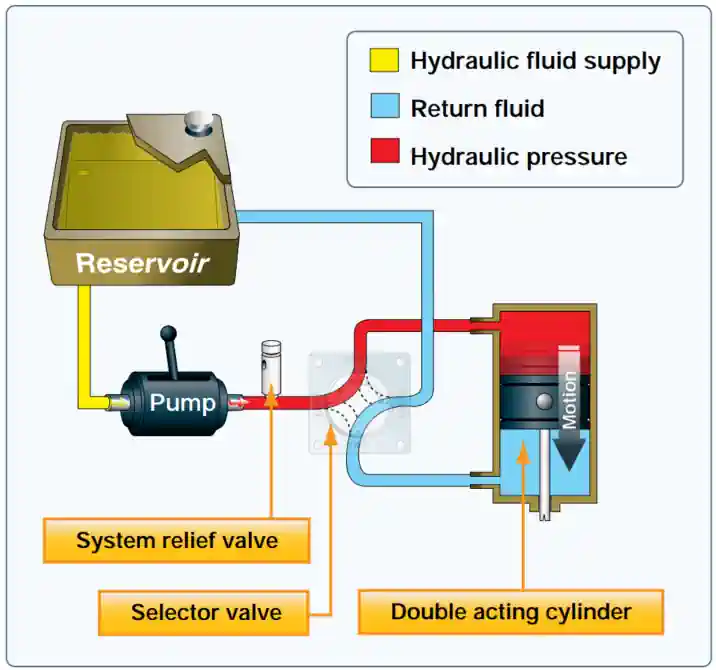
- A basic hydraulic system consists of: []
-
Hydraulic Reservoir:
- A mineral-based hydraulic fluid is the most widely used type for small aircraft.
- This type of hydraulic fluid, a kerosene-like petroleum product, has good lubricating properties, as well as additives to inhibit foaming and prevent the formation of corrosion.
- It is chemically stable, has very little viscosity change with temperature, and is dyed for identification.
- Since several types of hydraulic fluids are commonly used, an aircraft must be serviced with the type specified by the manufacturer.
-
Hydraulic Pumps:
- Hydraulic pumps may be either hand, electric, or engine-driven.
- The hydraulic fluid is pumped through the system to an actuator or servo.
-
Hydraulic Filters:
- Filters are necessary to keep the fluid clean.
-
Hydraulic Servos:
- A servo is a cylinder with a piston inside that turns fluid power into work and creates the power needed to actuate an aircraft system.
- Servos can be either single-acting or double-acting, based on the needs of the system.
- Therefore fluid can be applied to one (single-acting) or both sides (double-acting) of the servo, depending on the servo type.
- A single-acting servo provides power in one direction while a double-acting can provide power in both directions.
-
Hydraulic Selector Valves:
- The selector valve allows the fluid direction to be controlled.
- This is necessary for operations such as the extension and retraction of landing gear during which the fluid must work in two different directions.
-
Hydraulic Relief Valves:
- The relief valve provides an outlet for the system in the event of excessive fluid pressure in the system.
- Forces exert equal pressure on system
- Input smaller than output increases force
- Pumps provide system pressure
- Variable
- Constant: pressure regulators control pressure
- Pressure gauges provide a way to monitor the system
- Relief valves return fluid to the reservoir
- Check valves used for 1 way flow
-
Hydraulic Accumulators:
- Accumulators provide shock absorption for 1 time use
-
Hydraulic Acutators:
- Hydraulic actuators are the mechanical devices that translate hydraulic pressures into mechanical advantages
Hydraulics & Pneumatics Interactive Scenario
Interactive Scenario
Loading scenario details...
Decision 1
0%
Scenario Complete
Hydraulics & Pneumatics Knowledge Check
Private Pilot

Core Knowledge Review
Review the foundational knowledge, key concepts, and practical considerations for Hydraulics & Pneumatics.
Foundational
Immediate Feedback
Answer Explanations
Commercial Pilot

Advanced Application
Apply your knowledge of Hydraulics & Pneumatics to advanced operational scenarios, risk management, and aeronautical decision-making.
Advanced
Scenario Based
Risk Management
Why Take a Quiz?
Quizzes reinforce key concepts, identify knowledge gaps, and build confidence for real-world decisions in the cockpit.
Hydraulics & Pneumatics Conclusion
- Each system incorporates different components to meet the individual needs of different aircraft.
- More advanced aircraft tend to utilize higher pressurization in their system to simplify the engineering and reduce weight.
- Still looking for something? Continue searching: