Hyperventilation
Hyperventilation can impair pilot performance; recognizing its causes and symptoms supports prompt recovery and safer flight.
Introduction to Hyperventilation
- Hyperventilation results from a significant decrease in carbon dioxide content (CO2) in the blood that, left untreated, can result in incapacitation.
- You can make the symptoms of hyperventilation subside within a few minutes by consciously bringing your rate and depth of breathing back under control.
- In some instances, however, its effects can be debilitating.
- Prevention and proper awareness are key as a first-line defense against hyperventilation.
- Think you've got a solid understanding of hyperventilation? Don't miss the hyperventilation quiz below and the topic summary.
WARNING:
All aeromedical topics are GENERALIZED.
Always consult with a doctor or physician to understand your specific situation.
Hyperventilation Key Highlights
- Hyperventilation occurs when breathing rate or depth exceeds the body’s need for carbon dioxide exchange.
- Stress, anxiety, fear, and high-workload situations commonly contribute to hyperventilation during flight operations.
- Hyperventilation reduces carbon dioxide levels in the blood, which can impair normal physiological function.
- Symptoms may include dizziness, tingling sensations, visual disturbances, muscle spasms, and impaired concentration.
- Hyperventilation symptoms can resemble hypoxia, making accurate recognition important during flight.
- Pilots experiencing hyperventilation should consciously slow their breathing rate and focus on controlled breathing patterns.
- Talking aloud or breathing into a mask or closed system may help restore normal carbon dioxide balance.
- Effective workload management and stress reduction techniques can help prevent hyperventilation during demanding operations.
- Failure to recognize and correct hyperventilation can degrade pilot performance and aeronautical decision-making.
- Understanding hyperventilation improves physiological awareness, cockpit resource management, and overall flight safety.
Potential Causes of Hyperventilation
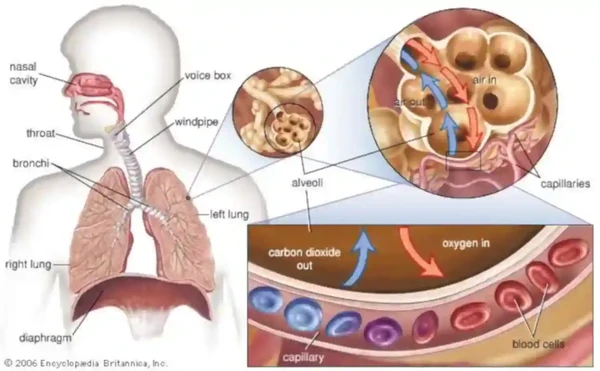
- Hyperventilation is an abnormal increase in the volume of air breathed in and out of the lungs. []
- Stress.
- Panic.
- Anxiety.
- Hypoxia.
- Decreased carbon dioxide in the blood.
- Under conditions of stress and anxiety, a person's body reacts automatically to such stimuli, whether the danger be imaginary or real.
- One of these automatic reactions is a marked increase in breathing rate, which results in a significant decrease in the carbon dioxide content of the blood, a necessary step to regulate the breathing process automatically.
- Risk factors provide pilots with additional context if they experience hyperventilation symptoms or if passengers experience them.
Hyperventilation Recognition
-
Hyperventilation Symptoms:
- As hyperventilation "blows off" excessive carbon dioxide from the body, a pilot can experience symptoms of:
- Lightheadedness.
- Nausea.
- Suffocation.
- Drowsiness.
- Tingling in the extremities.
- Coolness.
- Dry mouth.
- Blurred vision.
- Rapid pulse and breathing rate.
- Early symptoms of hyperventilation are similar to those of hypoxia and some to ordinary airsickness.
- Symptoms of both are not unique, and several can occur simultaneously.
- Therefore, if a pilot using an oxygen system experiences symptoms, they should immediately set the regulator to deliver 100% oxygen, check the system to ensure it functions effectively, and then adjust their rate and depth of breathing.
- Symptoms of both are not unique, and several can occur simultaneously.
- Symptoms can easily cause confusion and panic, which only aggravates the problem by further increasing anxiety and, thus, the breathing rate.
- As hyperventilation "blows off" excessive carbon dioxide from the body, a pilot can experience symptoms of:
-
Debilitating Effects from Hyperventilation:
- First and foremost, hyperventilation can be a significant distraction to the safe operation of the aircraft.
- Incapacitation can eventually result from a lack of coordination, disorientation, and painful muscle spasms.
- Eventually, unconsciousness can occur.
- Once identified, pilots and passengers must take immediate action to address the conditions that resulted in hyperventilation, as well as the debilitating effects that followed its onset.
Recovering from Hyperventilation
- The symptoms of hyperventilation subside within a few minutes after you consciously bring your rate and depth of breathing back under control.
- The buildup of carbon dioxide in the body can be hastened by talking loudly or controlled breathing in and out of a paper bag held over the nose and mouth.
- This method does not force you to breathe carbon dioxide but instead forces you to think about your breathing rate.
- This method may increase carbon dioxide levels too quickly, leaving it as a last resort.
- Recovery will occur within a few minutes.
- This method does not force you to breathe carbon dioxide but instead forces you to think about your breathing rate.
- If available, don an oxygen mask or system with the regulator set to 100% oxygen.
- Remove the cause of stress, panic, or anxiety as able.
- If the source is an emergency that requires immediate attention, take a moment to recall your emergency procedure training.
- If incapacitation occurs, then the body will naturally recover from the situation and slow the breathing rate.
- As always, avoiding the need to take immediate action to treat hyperventilation starts with prevention.
Hyperventilation Prevention
- Training, whether with an instructor or working through simulated scenarios, instills confidence in the event of a stressful situation.
- Systematic use of checklists during high-workload periods builds predictability, reducing anxiety.
- If the breathing rate increases for any reason, take note and focus on controlled breathing.
- Talking through a situation controls both breathing and stress.
- Physical fitness ensures the body is in top physiological shape.
Hyperventilation Interactive Scenario
Interactive Scenario
Loading scenario details...
Decision 1
0%
Scenario Complete
Hyperventilation Lessons & Case Studies
- The National Transportation Safety Board Identification: ATL90LA025:
- The NTSB determines the probable cause(s) of this accident to be: Pilot's temporary physical condition (possible hyperventilation or anxiety attack). Soft terrain during the emergency landing was considered a related factor.
- The National Transportation Safety Board Identification: DEN82DA125:
- The NTSB determines the probable cause(s) of this accident to be: Physical impairment (other organic problem of the pilot in command.
- The National Transportation Safety Board Identification: MIA78DLA01
- The NTSB determines the probable cause(s) of this accident to be: The pilot in command's misjudgment of distance and speed, and physical impairment from hyperventilation.
Hyperventilation Knowledge Check
Private Pilot
Core Knowledge Review
Review the foundational knowledge, key concepts, and practical considerations for Hyperventilation.
Foundational
Immediate Feedback
Answer Explanations
Commercial Pilot
Advanced Application
Apply your knowledge of Hyperventilation to advanced operational scenarios, risk management, and aeronautical decision-making.
Advanced
Scenario Based
Risk Management
Why Take a Quiz?
Quizzes reinforce key concepts, identify knowledge gaps, and build confidence for real-world decisions in the cockpit.
Hyperventilation Conclusion
- Hyperventilation is simply a matter of breathing too rapidly.
- It is seldom completely incapacitating, but it does produce one or more of the symptoms that are disturbing, if not alarming, to the uninformed pilot.
- Hyperventilation can look just like hypoxia, depending on the symptoms displayed, and has resulted in numerous fatal accidents.
- Understand the symptoms and how to recognize them in yourself and your passengers, along with the appropriate recovery methods.
- Still looking for something? Continue searching: