Steep Spirals
Steep Spirals improve pilot technique for power off turns, wind drift control, planning, orientation, and division of attention.
Introduction to Steep Spirals
- Steep Spirals simulate an emergency situation where an aircraft is required to descend as rapidly as possible to a forced landing
- Additionally, steep spirals improve pilot technique for power off turns, wind drift control, planning, orientation, and division of attention
WARNING:
All procedures are GENERALIZED.
Use the Pilot Operating Handbook (POH) procedures for specific aircraft performance and limitations.
and/or current Standard Operating Procedures (SOPs).
Steep Spirals Key Highlights
- Steep turns are coordinated turning maneuvers performed at high bank angles to develop aircraft control precision and situational awareness.
- Steep turns typically involve bank angles of approximately 45 degrees while maintaining constant altitude, airspeed, and coordination.
- Increased bank angle raises load factor and requires additional back pressure to maintain altitude during the maneuver.
- Steep turns increase induced drag and may require additional power to maintain airspeed and aircraft performance.
- Pilots must divide attention between outside visual references and flight instruments throughout the maneuver.
- Smooth and coordinated control inputs are essential to prevent excessive altitude, airspeed, or heading deviations.
- Overbanking tendencies increase as bank angle increases, requiring proper aileron control during the maneuver.
- Steep turns improve pilot understanding of load factor, turning performance, and aircraft energy management.
- Improper coordination or excessive angle of attack during steep turns can increase stall risk.
- Understanding steep turns improves aircraft control proficiency, maneuver coordination, and overall flight safety.
Steep Spiral Purpose
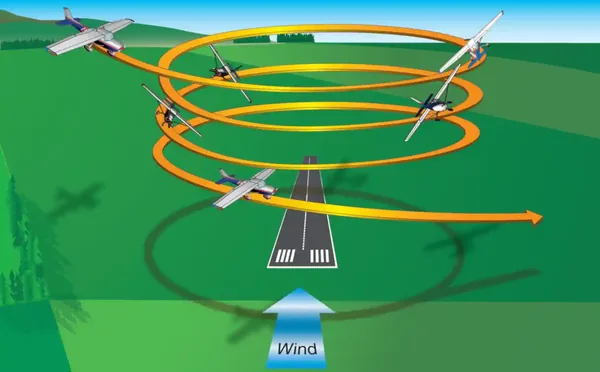
- The steep spiral maneuver provides an option from which to make a rapid descent from higher altitude, noteably when experiencing an emergency situation. []
Steep Spiral Procedure
- Select an altitude where recovery will occur no lower than 1,500' AGL and a descent will be no more than 2,000' total.
- Brief all passengers.
- Let passengers know what you are doing, to buckle up and secure all objects and how to avoid pressurization build up.
- Tell them to let you know if they have any problems.
- Determine wind direction.
- Perform clearing turns.
- Select a reference point in an area where an emergency landing can be made if necessary.
- Generally, enter on downwind.
- Fly almost directly over the reference point.
- Approaching the reference point:
- Enrichen the mixture.
- Abeam the reference point:
- Reduce the throttle to idle.
- Roll into a steep bank (not to exceed 60°).
- It is recommended to turn toward the side the pilot is sitting (left turn if in left seat).
- Maintain a constant radius.
- Adjust pitch to maintain. best glide or other specified airspeed (± 10 knots).
- As the wind direction changes in the spiral, adjust bank angle to maintain a constant radius around the reference point.
- Clear the engine on the upwind legs every turn.
- Turning upwind, clear the engine every 360°.
- Operating the engine at idle speed for prolonged periods may result in excessive engine cooling or spark plug fouling.
- Check engine operation during the glide by "clearing" the engine on every upwind (to minimize any variation in ground-speed and turn radius).
- Conduct a series of at least three 360° turns.
- Roll out toward an object or entry/specified heading (± 10°) and set cruise power.
- Maintain best glide or other specified airspeed (± 10 knots).
- Trim as necessary.
- Complete the maneuver no lower than 1,500 feet AGL unless combining the maneuver with an Emergency Approach and Landing.
- Complete the cruise Flow/Checklist.
Steep Spirals Common Errors
- Failure to adequately clear the area.
- Excessive pitch change during entry or recovery
- Attempts to start recovery prematurely
- Failure to stop the turn on a precise heading
- Excessive rudder during recovery, resulting in skidding
- Inadequate power management and airspeed control
- Attempting to perform the maneuver by instrument reference rather than visual reference
- Poor coordination, resulting in skidding and/or slipping
- Inadequate wind drift correct
- Failure to coordinate the controls, so that no increase/decrease in speed results when straight glide is resumed
- Failure to scan for other traffic
- Failure to maintain orientation
Steep Spirals Interactive Scenario
Interactive Scenario
Loading scenario details...
Decision 1
0%
Scenario Complete
Steep Spirals Knowledge Check
Private Pilot
Core Knowledge Review
Review the foundational knowledge, key concepts, and practical considerations for Steep Spirals.
Foundational
Immediate Feedback
Answer Explanations
Commercial Pilot

Advanced Application
Apply your knowledge of Steep Spirals to advanced operational scenarios, risk management, and aeronautical decision-making.
Advanced
Scenario Based
Risk Management
Why Take a Quiz?
Quizzes reinforce key concepts, identify knowledge gaps, and build confidence for real-world decisions in the cockpit.
Steep Spirals Conclusion
- The difference between a spin and a steep spiral is with a steep spiral, the aircraft is not stalled.
- Remain mindful that performance calculations are usually more optimistic than actual performance.
- Operating the engine at idle speed for prolonged periods may result in excessive engine cooling or spark plug fouling
- Check engine operation during the glide by "clearing" the engine on every upwind (to minimize any variation in groundspeed and turn radius
- This maneuver may be combined with simulated emergency approach and landing
- Consider actual versus realized performance when doing any performance calculations
- Consider practicing maneuvers on a flight simulator to introduce yourself to maneuvers or knock off rust
- Still looking for something? Continue searching: